Showing posts with label Knot of Leonardo. Show all posts

Sunday, 12 January 2014

New Work from Last Summer

I want to tell you about the three lutes that I finished last summer, on the very anniversary of my birth in late July: a 10 course, an 11 course, and a 6 course lute.  It seems a bit odd to call these 'new work,' some months having passed since their births--they're practically toddlers by now--but they're the latest instruments I've finished, so I guess they qualify.  (I've done quite a bit of work on a new group of lutes since then, and I think I may write a post on their progress in the near future.)

Let's start with the most strings first.  This is an 11 course lute, based on the Warwick Frei, for Dr. Gary Boye, of Boone, NC.


The back is of eastern hard curly maple, the belly of spruce from Switzerland.  The neck and pegbox are veneered in ebony.

The rose, whose pattern is taken from the original Hans Frei lute in the Warwick County Museum, is a favourite of mine, and I've talked about its mystery and beauty in this blog before.
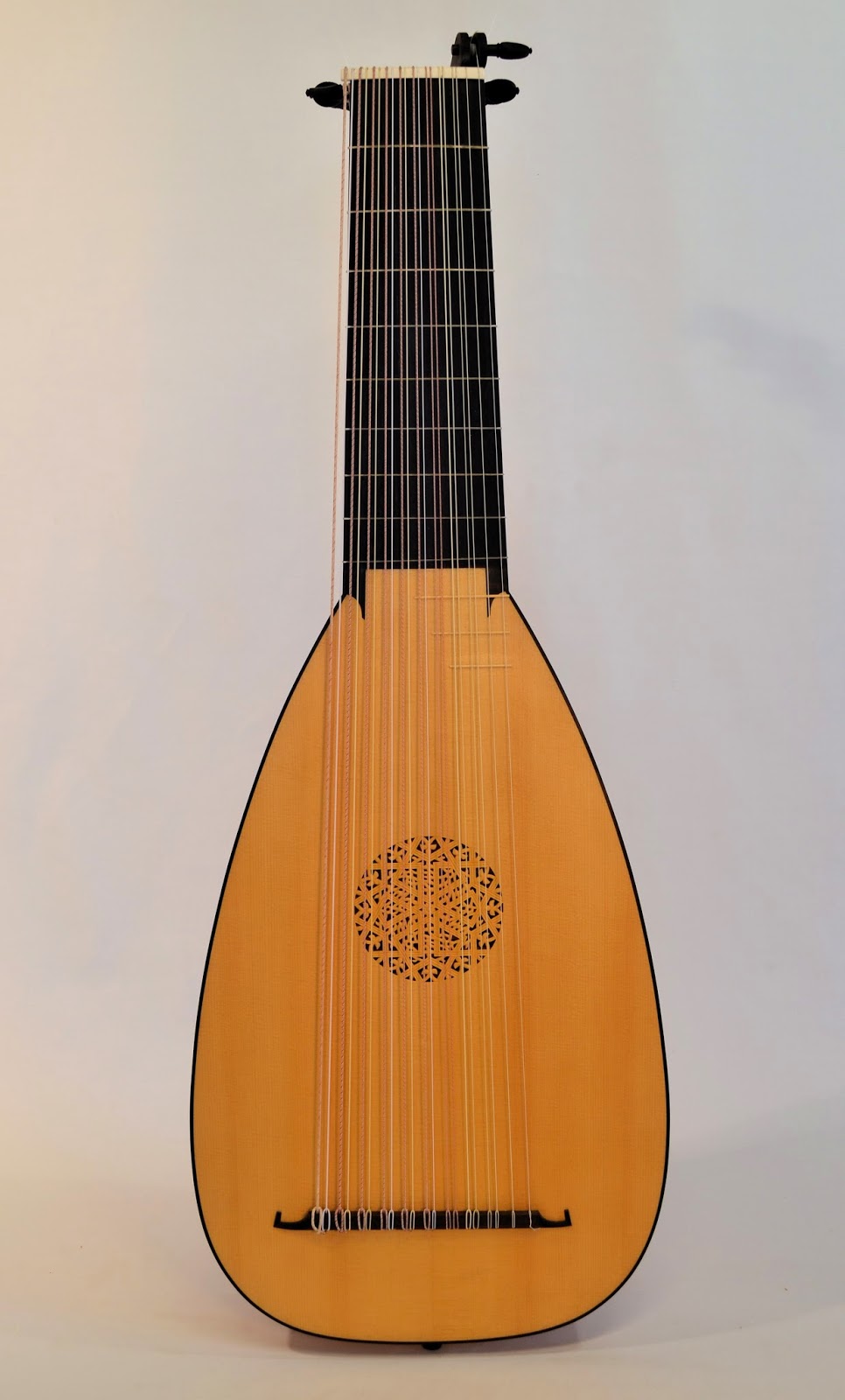
The second lute, with the second-most strings of the three, is a 10 course based on my reduced version (95%) of the body of the Tieffenbrucher archlute, C45 in the Vienna Kunsthistorischesmuseum.   I built it for Philippa Dunne, of Huntersville, NY.  This lute has become a popular model with me over the last few years, and I've built 7, 8 and 10 course versions of it with excellent results.  If anyone would care to try a 9c based on this model, just to complete the set, please let me know!


The back is of 17 pacific Yew ribs, with sycamore spacers.  For the 10 course model the string length is 64cm, which gives this lute 10 frets on the neck, with 9 of tied gut and the 10th of English boxwood.  

The rose is the familiar "knot of leonardo" pattern, with a chip-carved border; this feature is a nod to the rose of the Harton 10 course lute in the Folger Shakespeare Library.
The last lute to introduce today is a 6 course, which I built for myself.  It's not often that a lute maker finds the time to build himself a new instrument, and I was able to do so only because in the summer of 2012 I sold my previous lute, a 6 course after the small Frei, to Nelson Amos, of Ypsilanti, MI.  I loved that lute; it was my stalwart since I built it in 2007.  But many things had happened in my life, and in my lute making practice, since I made that lute, and over the years I had formed many ideas of what I would want in a new instrument: what string length,  what size and shape, what sound, what physical features concerning action and playability.  At the risk of sounding a bit grandiose, it was time to proclaim anew the state of the art of my lute making.  So here it is: 6 courses, 60cm string length, back of birdseye maple, the body shape of my own design, based on early 16th century Italian iconography.  I like my new lute a lot.  We get along really well, and look forward to getting to know each other very well over the years to come.


Grant Tomlinson taught me how to carve these flower-ends in a 6c bridge (Grant taught me just about everything I know).
Here's a nice detail shot showing soundboard, english boxwood body frets, pear fingerboard extending into the soundboard area, snakewood neck edging, pear binding around the belly.  Wood is beautiful!
The rose is my version of the Gerle pattern, which I've spoken about elsewhere.  What other choice did I have for my own lute, but what I consider to be the fundamental lute rose pattern?

That is all for now.  Stay well until we meet again; I'm off to play the lute.


Saturday, 7 September 2013

(Old) New Work

Hi friends,

Hope you've all been well since we last talked.  I haven't posted in a while, but feel like I'm about to unleash a flurry, nay, a veritable barrage, of new posts, in the coming days and weeks.  I had a great summer, and I hope you did too, and I feel really recharged and ready to get back to work, both in the shop and on la blogue.  So here goes!

First up is a bit of old-ish business--some photos of a 13c lute that I finished late in 2012, in a group of two alongside the 12c lute that is the subject of my previous post.  This lute has a body based on the Paris Schelle, with an extension after Widhalm, just like the one that I built, and posted about, in 2011.

This lute has a back made of Honduras rosewood ribs and holly spacers, with ebony fingerboard, points and neck veneer; the extension is made of English sycamore, dyed black, with Castella boxwood pegs.  It was originally built for a European client who was, unfortunately, unable to take delivery.  The lute now belongs to Dr. Ken Lee of Vancouver, BC.

Incidentally, this set of photos is the inaugural one featuring my new digital SLR, a Nikon D3100.  My digital photography skills are still developing, as is my lighting rig and studio setup, but I think it's an improvement over previous efforts.  Enjoy....


That's most of the shots I've got of this one--there are a few others on my flickr page, if you want to check it out.  More stuff soon!

Wednesday, 28 September 2011

Fresh-baked lutes! Get 'em while they're hot!

Hi everyone--hope you had a great summer.  Mine was fantastic--among many other adventures, the Lute Society of America Workshop was held in August at UBC, and I was the Lute Doctor.  I got to meet a lot of old friends and new friends, and got to meet a whole lot of lutes (and tie a whole lot of frets!)  I'll post a pic or two on an upcoming blog post--for now, I have some older business to tell you about.

Last I posted was in late June.  I was working on three lutes at the time,  an 11c lute, an 8c, and a 13c.  Well, the good news is that all three are finished, all three turned out fabulously well (if I may say so myself), and all three are with their new owners, in their new homes--Seattle, Washington; Homer, Alaska; and Sydney, Australia.  Here they are, the finished products:

The 11c Frei--


The 8c Tieffenbrucher--


And the 13c Schelle (with an extension after Leopold Widhalm)--


 Three new lutes; a good winter's work.  I'm on to new projects now, but for the moment I'd like to dwell on the 13c lute, specifically the pegbox extension.  It was the first time I'd made one of these beasts, and it was a big challenge, and a lot of fun.  I'll tell you about it in the next post--soon!

Saturday, 12 March 2011

My February

Ah, February, the longest, shortest, dreariest, happiest month.  How did you spend your February?  Were you on a beach in some sunny place, trying your best to forget the frozen misery back home?  Or did you bar the door, curl up by the fire and pluck your lute by the flickering light?

I must admit I did some of the latter in my February (though there was no actual fireplace involved--only the warmth and light of my lovely bride Julia).  In the lute shop, I carved.  I also planed, and sawed, and scraped, and drilled (and occasionally swept the floor); but mostly, I carved.

I selected three of my best soundboards, planed and scraped them to an appropriate thickness, and then in each of them I carved a rose.  Have a look.


This is the rose I carved for the 8 course lute.  Like all of the lute rose patterns I use, it's an historical pattern, and it's from an archlute of 1639 by Matteo Sellas.  (This version of the pattern was drawn by Ray Nurse).   I hadn't carved this pattern before, but I was eager to do it--I really like the balance of space and substance, and the combination of geometric and organic elements.


This is the rose for the 13 course Schelle lute.  It is not the pattern that appears on the original Paris Schelle (that rose is actually carved from a separate piece of pear wood, and then inset into the belly of the lute).  Instead, this rose is a version of the "knot of leonardo" pattern that appears--in different sizes, and with and without the decorative chip-carved border--on many surviving old instruments.

 
And here is the rose for the 11 course Warwick Frei.  This is the pattern from the original Frei lute, and it is one of a kind--the only surviving historical lute on which this rose pattern appears.  No wonder!  The small lace-or web-like elements are quite painstaking to cut.  Indeed, there's such a combination of different things going on in this pattern--large and small bits, vines, webs, fleurs-de-lis, geometric elements--that it's kind of amazing that the pattern 'works' at all.  And yet it does... To me, there's something in this rose that feels very old, very fundamental, even archetypal.  It brings a shiver.

Perhaps you can tell that I really, really enjoy carving a lute rose.  It's true.  However, like practically all the thousand-and-one jobs involved in making a lute, I am happy while I am doing it, but I am happy when it's done.  I can set the work aside, clear the bench, sharpen my tools, and go on to the next job.

The next job, as it turns out, is to make bridges.  The bridges for these lutes are all made of plum (my preferred wood for this piece of equipment), but each bridge is made in a separate style with its own distinct features.

The 8 course bridge is a design after Tieffenbrucher, dyed black with incised lines and branded with six-petalled flowers.
The 11 course design is from a lute by Vendelinus Tieffenbrucher, dyed black with incised lines and branded with eight-petalled flowers.  It will also have ebony tips added once it's glued to the soundboard.
And finally, the 13 course bridge is based on the bridge from the Paris Schelle--this one isn't dyed black, but has an ebony cap (and it will also have ebony tips).
So there, that's most of my February.  I also did plenty of other stuff (But Travis, I hear you exclaim, how much more can a single human being do in one month?), but that's the most spectacular.  Much work in building a lute is done behind the scenes and does not reveal itself until later.  All will be revealed in the fullness of time....