Showing posts with label Frei. Show all posts

Thursday, 19 June 2014

The Unusuals

Today I'm pleased to report some new work completed, three new lutes making their way in the world.  Together they are "The Unusuals" because each in its own way has some oddities, or peculiarities, that mark it as memorable.

First up is an 8c lute based on the Tieffenbrucher archlute, C45 in the Vienna Kunsthistorisches Museum.  My version here is reduced to about 95% of the original body, which allows for a slightly shorter string length (this lute has a string length of 63cm, with 9 frets tied on the neck).  This lute was made for Dr. Ken Lee of Vancouver.
The back is of Honduras rosewood (with holly spacers), a wood that I haven't used for this model before.  My initial impressions of it are that it creates a very powerful, clear and focused tone. It's perhaps not the most complex tone that you might hope for, but it is quick and strong.  I think it will make a very nice concert instrument; my impression is that it could fill a small hall (relatively) effortlessly.

My client had some specific requests for this lute.  He asked for both the first and second course to be single strung; he also asked for a set of mechanical pegs (Pegheds) to be installed.  I find that I'm being asked to install these pegs more frequently, which I don't really a problem with, though it does hurt my pride in my own traditional wooden peg-making and fitting just a teeny bit.   In my limited experience, the Pegheds seem to work well, though I must say they are not without difficulty to install.

One other unusual request by my client was the rose design: the rose from the 1592 Venere lute in Bologna.  I usually think of this pattern as belonging to that particular model of instrument (since it's the only surviving historical instrument on which it appears), but that's no reason not to use it elsewhere.  I think it works well on this lute.


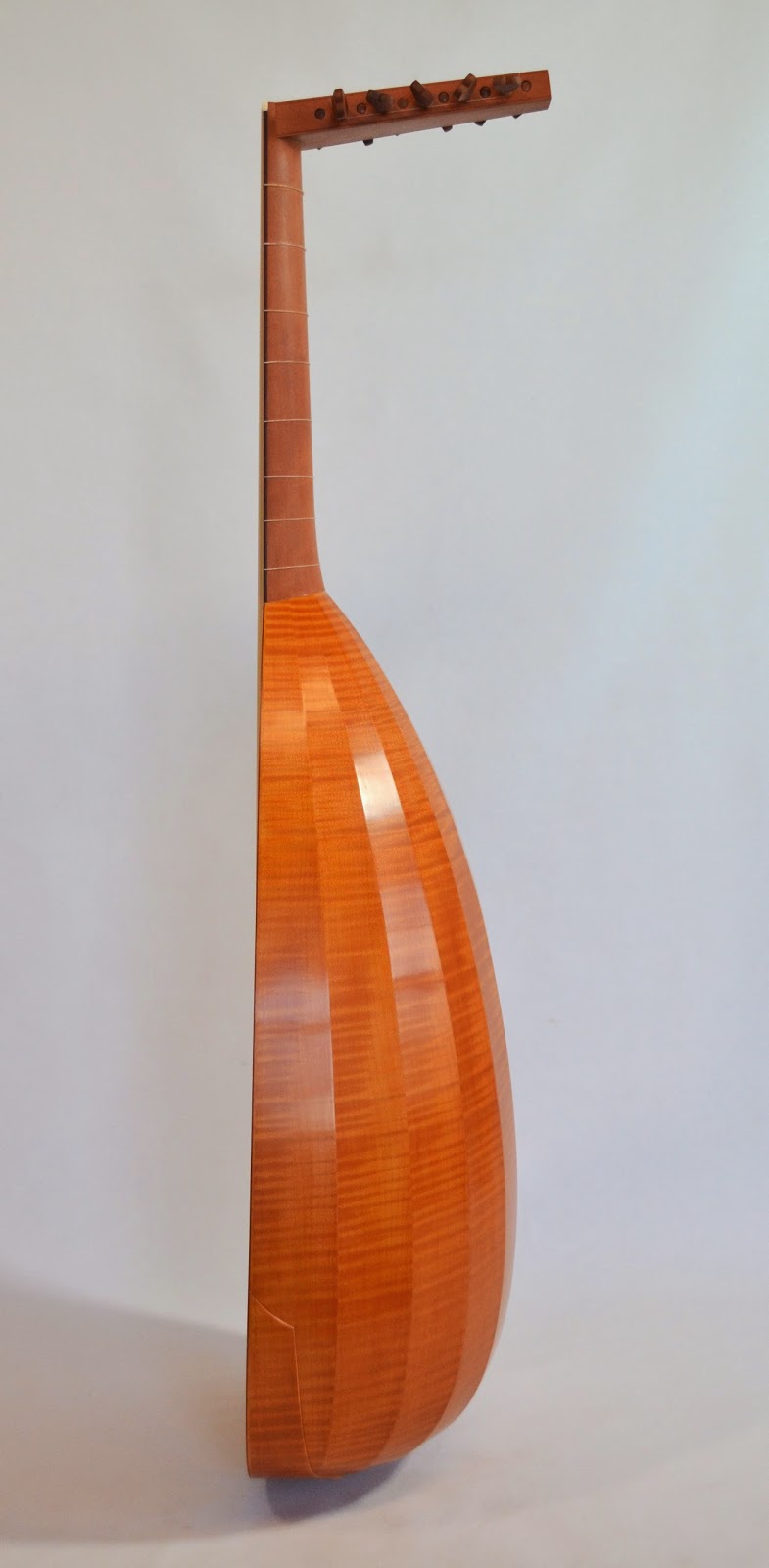
The next recently completed lute is a 6c version of the Warwick Frei lute.  I've made a number of 11c versions, but this is the first 6c version I've done of this lute.  It has quite a long string length at 71cm, but I must say I felt no difficulty in playing it--the shape of the body seems to fit easily against the player's body, and once one finds a correct way of holding it, it is quite comfortable to play.   I made this lute for Sten Hansen of St. Charles, IL.


The most unusual aspect of this instrument, for me, was the thickness of the soundboard and the dimension, number and location of the soundboard braces.  As outlined in my last blog post, I used barring and soundboard thicknessing that corresponded with the evidence that I saw in the historical lute: an unusually thick belly, a five-bar brace pattern, and a j-bar that spanned the width of the belly.  These may seem like small adjustments on their own, but taken together they are, I think, a fairly radical departure from conventional systems (or at least my own conventional systems).

I think the experiment was a resounding success (but I guess you should ask Sten about that to be sure).  The lute has quite a big sound, with a bright, singing chanterelle and a strong response across the whole range.  The timbre of the instrument is...well...unique.  I haven't heard anything quite like it, and I'm a little baffled at how to describe it.  (This is an ongoing issue for me--how to describe a sound.   Sten and the lute will be in Cleveland next week, at the Lute Society of America Summer Seminar, and I plan on listening for people's responses, and collecting their adjectives.  I will report back in a future blog post.)

 The rose pattern, as I've said before, is one of my favourites, both to look at and to carve.

And I love the way so many different woods arrive at one point, here at the body-neck joint: pear neck and fingerboard, snakewood fingerboard edging, curly maple ribs, spruce soundboard, pear belly edging, boxwood frets.
Last of The Unusuals is the most unusual of all: a five course, fretless medieval lute, built for Gus Denhard of Seattle.  This one is so unusual I will devote an entire future post to its design and construction.  This one stretched me to the limits of my craft skills unlike any other I've made.  At the risk of sounding a bit cocky, after building this one, I think I could build just about anything. 

The broad-ribbed, nearly semicircular back, along with the ribs re-curving into the neck were a fair challenge, but the tile work on the belly and herringbone edge binding--both shop-made--were no less tricky.  I'm quite pleased with the result.

Gus came to my workshop this week to pick up the lute, and in his hands it sounded great.  I think this lute has been a dream of his for a while, and now that he has it, he will be the one to create its repertoire.  That's a great reward for me, to be able to create the vehicle for another person's musical adventure.  A lot of the time, I feel like the luckiest guy on the planet.

And that is all for today.  I'm off to the LSA Seminar in Cleveland tomorrow--I hope to see you there!


Sunday, 16 February 2014

Work in Progress, February 2014

Three lutes are underway right now, an 8 course, 6 course and 5 course, and each presents unique design and construction challenges.   The 8 course lute is a version of the reduced Tieffenbrucher C45 model I've made many times, but with some very specific features requested by the client; the 5 and 6 course lutes are wholly new models for me, and in many ways take me into some rather interesting and uncharted territory.  

First to the 8 course: this lute has a back of Honduras rosewood, a material that I haven't used on this model before.  Other specific features of the lute arise from the fact that the client plans to play this lute with fingernails.  In response, I've made the bridge slightly taller than normal (to provide a bit more clearance of the strings above the belly); the string spacing at the bridge is a little narrower than my shop standard; and the second course will be single-strung.  One other unique feature of this lute is that the client has asked me to install a set of mechanical pegs.

This group of lutes is pretty far along in the construction schedule, and in fact, I glued the bellies into the bodies of all three last week.   Here's a shot of the 8 course just before gluing in.
Next up is the 5 course, a fretless, plectrum-style medieval lute.  It's based on a late-14th century painting, which I'll talk about in a future post.  For now, I'll just point out some features that make this lute unlike any I've built before.  It's more like an 'ud, in many ways--
As you can see, the belly has two roses, a pretty common feature in pre-16th century lutes, judging by surviving iconography.   It also has a 'scratch plate'--an 'ud-like feature--between the bridge and the main rose, to guard against damage from the plectrum, as well as a wide bridge, mosaic inlays, and rose patterns that are very simple in comparison to the kind of roses one sees on most Renaissance lutes.  (The simplicity of the roses is more than compensated for by the overall busyness of the belly's design, which you'll see better when I post pics of the finished instrument.)   The lute also has a curved neck joint, which is covered by the belly in this photograph (but you can see the shape of the joint by looking at the top of the belly, in the area of the upper rose).

The main difference between this lute and any other I've built is the soundboard thicknessing and barring.  Making mainly Renaissance lutes, one gets rather accustomed to building in a certain style, with a certain pattern of thicknessing and barring which, though it varies somewhat from model to model, is fairly well-defined both by the old treatises and by examples from historical instruments in museums.  That pattern looks a lot like this, which is the one on the 8 course lute shown above:
This is called a "seven-bar" pattern: there are three main bars across the belly below the rose, and three main bars above it, while the three small bars across the rose are counted as one.  There are also small bars at the bottom of the belly: two "treble bars" that poke in from the corner (that help to focus and support the sound of the higher-pitched courses) and the "j-bar" (that helps to control the lute's bass response.)

It's a pretty complicated system, well-suited to the sonic complexities of the late-16th century lute and its music.  But what kind of barring system should we use for a 5 course lute?  Besides all the structural differences (two roses, inlays, scratch plate, etc.), the origins of this lute lay at least 200 years earlier than the 8 course, in a vastly different musical culture.  And, unfortunately, there are no late-14th century lutes lying to hand for us to x-ray or pry apart to see how they built them back then.  For this lute, we are in the realm of educated guess work.

But we do have a guide... and his name is Ray Nurse.   Ray's well-known as a musician, teacher, lute maker, musicologist, and all-round giant brain (he's also my close neighbour here in East Vancouver).   In 1988 Ray wrote a paper called "Design and Structural Development of the Lute in the Renaissance," which, among other things, outlines a tantalizingly plausible line of development for lute belly thicknesses and barring systems.  I won't rehearse Ray's whole argument here (the article is available for download--just do a google search), but suffice it to say that, generally, the further back in time we go, the fewer the bars, and the thicker the soundboard.  How few the bars, and how thick the belly, are a matter judgment, and a reading of (admittedly scant) historical evidence.  Here's what I used for the 5 course:
A four-bar pattern--and a reasonably thick soundboard too.  Notice that on this lute, there are no treble bars, and no j-bar.  I'm banking a bit on the likelihood that there won't be much to differentiate the treble and bass responses of this lute, and therefore the small bars that 'balance' the sound in the 8 course lute won't be necessary.  (I'll let you know how this all works out when I string up the lute!)

Now on to the 6 course.

This one is based on the lute by Hans Frei in the Warwick County Museum, otherwise known as the Warwick Frei.  The Warwick Frei's present configuration is as an 11 course (which is how I've built it previously), but it would have started life somewhere in the early-to-mid 16th century as a 6 or 7 course lute (the conversion to 11 courses happened in the 17th century).  It's a reasonably easy task to figure out what the overall shape of the original instrument might have been--neck length, number of frets, string length, etc.--but as with the 5 course lute above, figuring out a plausible "original" belly and barring for this lute is a quite a different matter.

There is some evidence, though, of what these things might have looked like 'under the hood' in the 16th century.  The soundboard, for instance, appears to be original, and, especially in the lower half of the belly, from about the rose down, it is quite thick--as much as 2.5 mm at the very bottom.   As for the barring, what's on the belly now is not original, and is likely a part of the 17th century conversion (it's a pattern somewhat like the one on the 8 course lute, above).  However, glue marks on the underside of the belly show pretty clearly where an earlier set of bars (the originals?) were located.
For my version of this lute, I decided to believe the evidence: I used the thicker soundboard measurements, and the earlier barring pattern.  It's a five-bar pattern, as you can see, but there's another feature I've taken from the original: a j-bar that spans the whole width of the belly.  It's very unusual--I've never seen evidence of such a thing on another historical lute belly--and I'm quite interested to find out if I've been able to balance treble and bass responses without the aid of the little treble bars.

So that's the lute's progress for now.  Much work has been done, and there's much more still to come, but for now, with the bellies glued in place, it's a good time to stop and reflect.   All the thinking I can do, all the planning and testing, have been done, and there's nothing left but to say a little prayer for luck as I seal up my hopes inside each lute.  Every lute is, in a sense, a leap into the unknown, but that's true for these ones especially.  I really feel like I'm pushing at the boundaries of my knowledge with them.  Hopefully I'll make some useful discoveries--and the lutes will make some beautiful sounds.

Until next time....


Sunday, 12 January 2014

New Work from Last Summer

I want to tell you about the three lutes that I finished last summer, on the very anniversary of my birth in late July: a 10 course, an 11 course, and a 6 course lute.  It seems a bit odd to call these 'new work,' some months having passed since their births--they're practically toddlers by now--but they're the latest instruments I've finished, so I guess they qualify.  (I've done quite a bit of work on a new group of lutes since then, and I think I may write a post on their progress in the near future.)

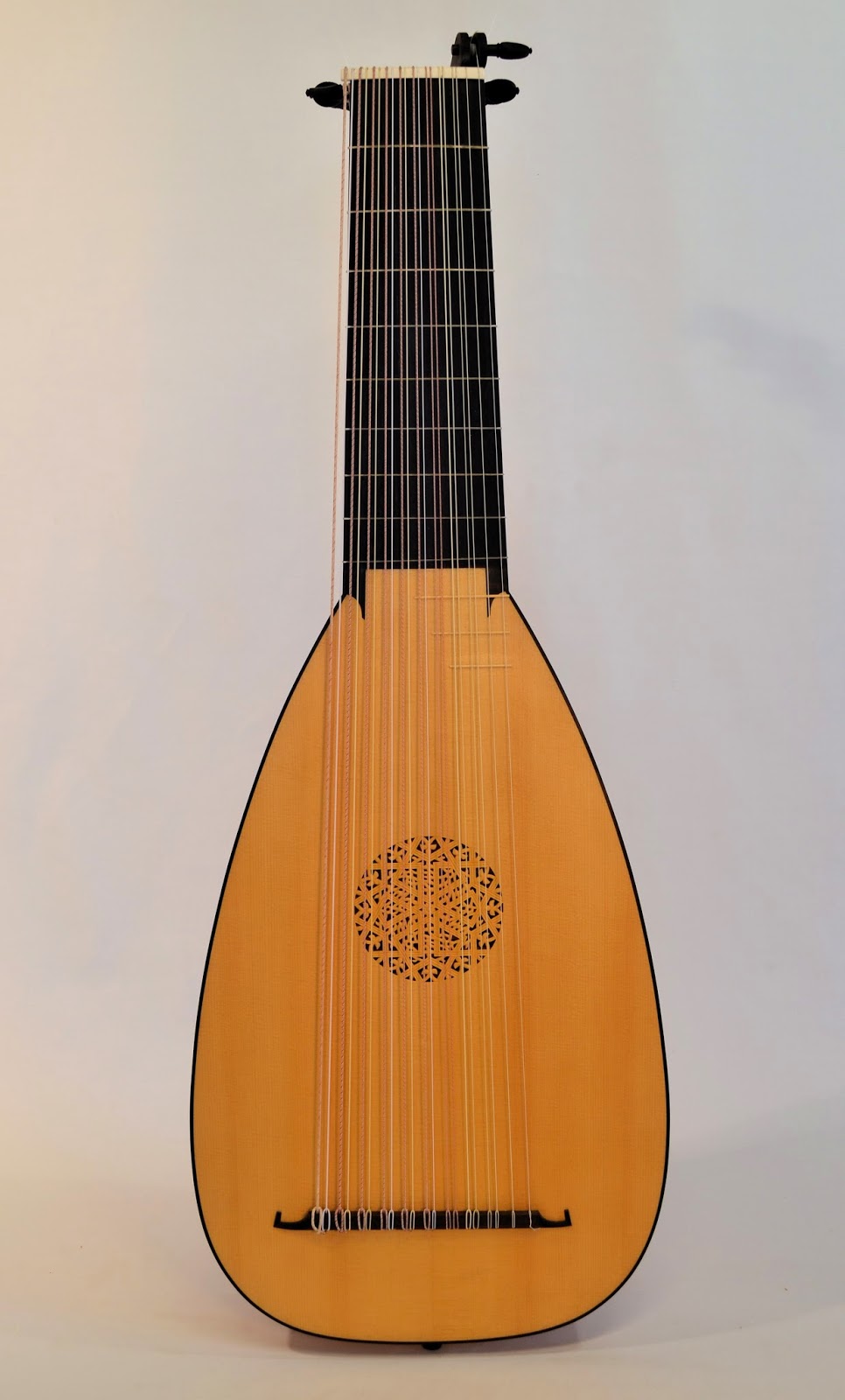
Let's start with the most strings first.  This is an 11 course lute, based on the Warwick Frei, for Dr. Gary Boye, of Boone, NC.


The back is of eastern hard curly maple, the belly of spruce from Switzerland.  The neck and pegbox are veneered in ebony.

The rose, whose pattern is taken from the original Hans Frei lute in the Warwick County Museum, is a favourite of mine, and I've talked about its mystery and beauty in this blog before.
The second lute, with the second-most strings of the three, is a 10 course based on my reduced version (95%) of the body of the Tieffenbrucher archlute, C45 in the Vienna Kunsthistorischesmuseum.   I built it for Philippa Dunne, of Huntersville, NY.  This lute has become a popular model with me over the last few years, and I've built 7, 8 and 10 course versions of it with excellent results.  If anyone would care to try a 9c based on this model, just to complete the set, please let me know!


The back is of 17 pacific Yew ribs, with sycamore spacers.  For the 10 course model the string length is 64cm, which gives this lute 10 frets on the neck, with 9 of tied gut and the 10th of English boxwood.  

The rose is the familiar "knot of leonardo" pattern, with a chip-carved border; this feature is a nod to the rose of the Harton 10 course lute in the Folger Shakespeare Library.
The last lute to introduce today is a 6 course, which I built for myself.  It's not often that a lute maker finds the time to build himself a new instrument, and I was able to do so only because in the summer of 2012 I sold my previous lute, a 6 course after the small Frei, to Nelson Amos, of Ypsilanti, MI.  I loved that lute; it was my stalwart since I built it in 2007.  But many things had happened in my life, and in my lute making practice, since I made that lute, and over the years I had formed many ideas of what I would want in a new instrument: what string length,  what size and shape, what sound, what physical features concerning action and playability.  At the risk of sounding a bit grandiose, it was time to proclaim anew the state of the art of my lute making.  So here it is: 6 courses, 60cm string length, back of birdseye maple, the body shape of my own design, based on early 16th century Italian iconography.  I like my new lute a lot.  We get along really well, and look forward to getting to know each other very well over the years to come.


Grant Tomlinson taught me how to carve these flower-ends in a 6c bridge (Grant taught me just about everything I know).
Here's a nice detail shot showing soundboard, english boxwood body frets, pear fingerboard extending into the soundboard area, snakewood neck edging, pear binding around the belly.  Wood is beautiful!
The rose is my version of the Gerle pattern, which I've spoken about elsewhere.  What other choice did I have for my own lute, but what I consider to be the fundamental lute rose pattern?

That is all for now.  Stay well until we meet again; I'm off to play the lute.


Wednesday, 28 September 2011

Fresh-baked lutes! Get 'em while they're hot!

Hi everyone--hope you had a great summer.  Mine was fantastic--among many other adventures, the Lute Society of America Workshop was held in August at UBC, and I was the Lute Doctor.  I got to meet a lot of old friends and new friends, and got to meet a whole lot of lutes (and tie a whole lot of frets!)  I'll post a pic or two on an upcoming blog post--for now, I have some older business to tell you about.

Last I posted was in late June.  I was working on three lutes at the time,  an 11c lute, an 8c, and a 13c.  Well, the good news is that all three are finished, all three turned out fabulously well (if I may say so myself), and all three are with their new owners, in their new homes--Seattle, Washington; Homer, Alaska; and Sydney, Australia.  Here they are, the finished products:

The 11c Frei--


The 8c Tieffenbrucher--


And the 13c Schelle (with an extension after Leopold Widhalm)--


 Three new lutes; a good winter's work.  I'm on to new projects now, but for the moment I'd like to dwell on the 13c lute, specifically the pegbox extension.  It was the first time I'd made one of these beasts, and it was a big challenge, and a lot of fun.  I'll tell you about it in the next post--soon!