Showing posts with label 10 course. Show all posts

Wednesday, 21 November 2018

Recent Work, Summer 2018

Hi everyone--I have four new lutes to present to you today.

You may have already seen pics of these that I posted a month or two ago on Facebook. If that's the case, and I've dragged you here under false pretences by calling this post "Recent Work," well, I'm sorry--you're free to go. However, if you're not in too big a hurry, by all means stick around and I'll try to add a few comments, to make the visit worth your while.

I started this group of four in late 2017, hoping to have them finished before the summer of 2018, which I knew was going to be a busy one. I didn't quite get them all done before summer, but instead finished them one at a time, in June, July, and August. I'll present them here in the chronological order of their completion.

I always work in groups, usually two or three. I think that there are some efficiencies to be gained by doing the same or similar jobs across a number of instruments (carving roses, making necks, putting backs together, etc.) Once you've taken the time to set up your tools to do a job once, you might as well do it two or three three times and make it worth your while.

At least that's the theory.... After working this way a number of times I still think it's true, but there is a limit to how many instruments a person can work on without something like boredom setting in. Four lutes might be the limit for me. Progress in the shop can seem slow at the best of times, but working on a large group means progress often seems to come in very tiny increments. You need to be okay with going into the shop each day and being greeted by a bunch of lutes that don't look like they've moved along very much in quite a while. (I keep expecting the Lute Elves to show up overnight or over the weekend and, say, finish carving the bridges I left half-done for them, but alas they never do....)

Luckily, I'm a patient person--I think that's probably very high on the list of qualifications for being a lute maker. And, thankfully, I have clients who are very patient people too.

The first lute of the group, finished in late June, was a new model for me: a 6 course with a string length of 54cm, in modern pitch a', for George Moss of Kansas City, MO. It's from a design by Grant Tomlinson, which he based on early-16th century Italian models. I actually built this lute using Grant's mold, which he lent to me; he also sold me the lovely set of German maple ribs for the back, which, according to his notes, he'd sawn in 1982. (I asked him if he'd care to come over to my shop and build the lute for me too, but sadly he declined.)

It made a lovely little lute with a very sweet, rich, balanced sound. In my experience, lutes in a' don't generally have a problem making their treble register heard--indeed, they can be a bit overbearing. Not this one, though. I was a little surprised--and pleased--at the presence and warmth of the basses, and in general the balance of sound throughout the register.  To me, it sounded not so much like an a' lute, but instead like a really good 6 course lute that just happened to be tuned in a' (if you get what I mean.)


Mug shots front and back: the neck, fingerboard and peg box are pear, and the bridge and tuning pegs are plum. The back, as I said, is of German maple, and the belly is one of my finest pieces of alpine spruce. The fingerboard edging is snakewood.


As usual, I supplied a number of possible rose designs to my client, and George decided to go with a pattern from a baroque lute--an 11 course, I believe--by Martinus Kaiser (I don't have the date of that lute to hand just now.) As with so many old lute rose patterns, this one works a variation of the Star of David, with twisting vines and leaves contrasting with the geometric basis.


This lute was finished in time for me to hand-deliver it to George at the Lute Society of America LuteFest in Cleveland at the end of June. He liked it! I was pleased. Then after the week of lute festivities I returned to Canada to do a little repair work, which you can read about here; then met up with my darling wife Julia for a holiday trip that included stops in Montreal, eastern Ontario, Vermont, New Hampshire, and Rhode Island. Lakes, rivers and oceans were swum in, rare liquors tasted, fine cuisines sampled, and old friends, and new friends, were met. By late July, we were back in Vancouver--and I was back in the workshop, rested, and eager to finish up the next lute.

This one was another new model for me: a 'théorbe de pièces,' or 'Lesser French Theorbo,' for Bruce Burchmore of Los Angeles, CA.


This project was a lot of fun, and a real challenge.  There are so many interesting features to this instrument, and much of its design had to be done pretty much from scratch. I had no museum drawing to work from, and really not much expertise to go on to get me started. I didn't know the instrument, and I didn't know the repertoire. I did a lot of learning along the way, from a whole bunch of teachers and advisers, starting with the very patient Bruce Burchmore, and including Grant Tomlinson, Ray Nurse, and my old friend Nelson Amos. I think there's a tale here, and I'll tell it in my next blog post.

Some data: the top string is in d (A=392), and the top two strings are re-entrant (i.e., an octave low.) The string length to the first nut is 72cm, and to the extension 114. There are 14 strings, 8 to the first peg box, and 6 to the extension. The fingerboard, belly edge binding and neck veneer are ebony; and the extension is made of two pieces of English sycamore, dyed black. The belly, as always, is one of my finest sets of European alpine spruce; and the back of the lute is 11 ribs of curly maple.

The rose pattern I used is known as the 'Mouton,' since it is taken from the famous painting of the lutenist Charles Mouton by François de Troy. This version of the pattern was drawn by Ray Nurse.

Perhaps the most striking feature of this type of lute is its extension, which basically consists of a plank of wood with a cutout for a carved panel at the back of the lower peg box, and a second peg box carved from a separate block of wood, attached to the far end of the plank. I've made lutes with extended necks before, but nothing quite like this. I think it's a really cool design, and aesthetically it seems totally of a piece with the refinement of the music that's played on the lute.

I found this lute compulsively photographable. (If you'd like to see further evidence of the compulsion, please go to my flickr page.) Most lutes are like a little world unto themselves, and some of them, like this one, seem incredibly vast. They will not be captured by a single photo, or even a hundred. But I try!

OK--next lute. We're now into mid-August: Julia and I are back from a short trip to the interior of BC,  where we holidayed with my mom and sister, who had driven out from Saskatchewan. The lakes and rivers of the BC interior are beautiful, and we swam in them daily. The air, however, was thick with smoke from wildfires; a new reality, a constant companion in the summers. Back to the coast, where the air is (relatively) clear.

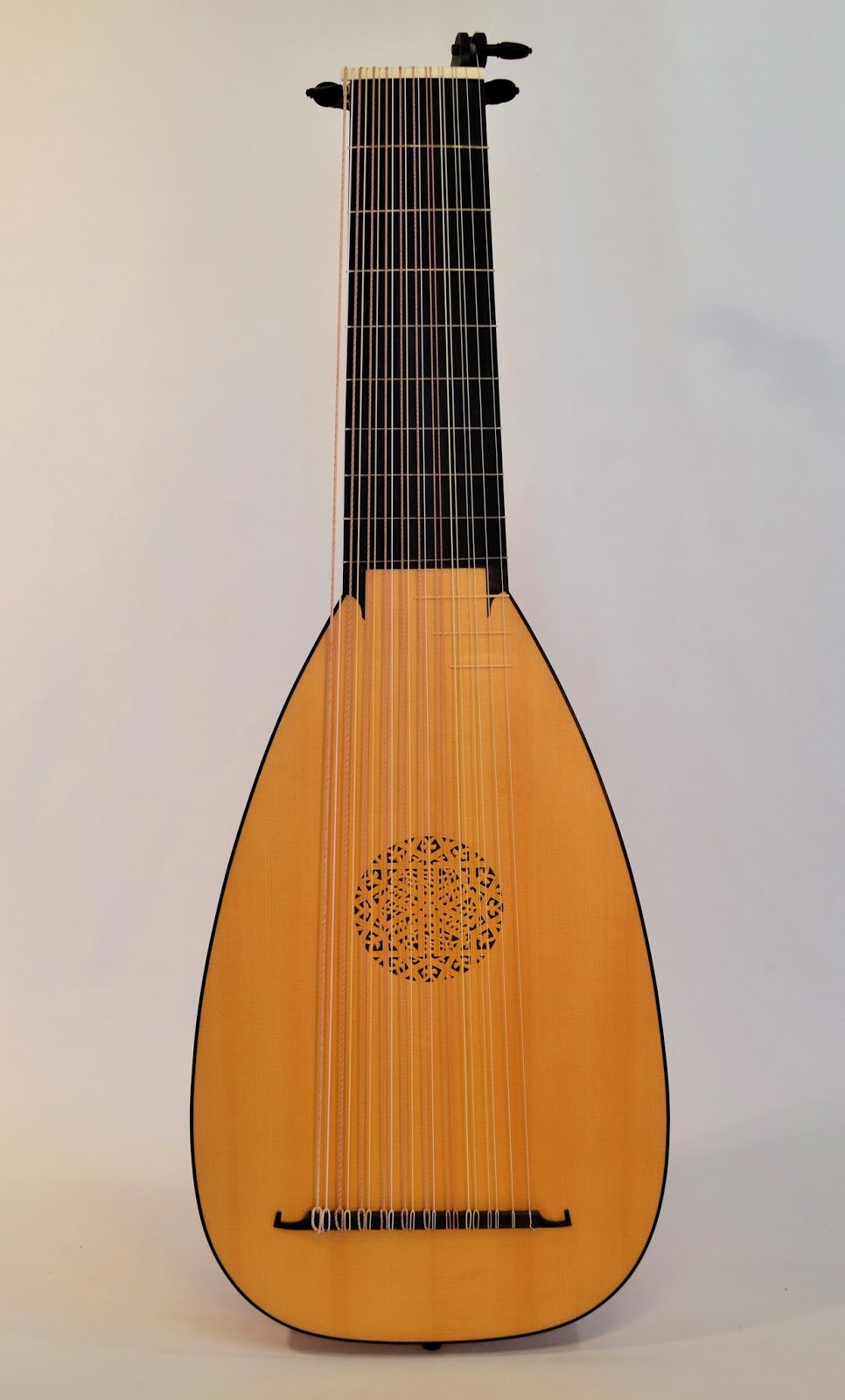
This lute is not a new model--it is a 10 course lute based on the body of the Tieffenbrucher archlute, C45 in the Vienna KHM, which I've scaled down to 95% of the original. (The back is 17 ribs of dark, heartwood pacific yew.) I have built a number of 10 course lutes on this model, along with a few 7 and 8 course as well, and all of them have been very successful.  Reducing slightly the original size of the body allows a string length of 64 cm (while retaining 9 tied frets) which is a convenient length for stringing in g', either in modern or low pitch.

For this lute, my client, Mark Bagley, of Madison, MS, asked me to try to come up with a design that reduced the string length as much as possible, while still tying 9 frets easily. A little squeezing here and there--shortening the neck a little, raising the bridge position just a few millimeters (and correspondingly adjusting the location of soundboard bars and, in consequence, the position of the rose)--gave a string length of 62 cm. A very manageable length for a 10 course lute!

One thing that was different about this lute was the suite of veneers that I made for the neck and peg box. Mark had asked for a special look for this lute, so I suggested a design based on the 1609 Magno Dieffopruchar lute, 144 in the Museo Bardini in Florence. Here's what the original looks like (photos by Stephen Gottlieb, courtesy of Grant Tomlinson):


And here are some shots of my version. The veneers on the Dieffopruchar are made up of strips of ebony and ivory; my version is made of ebony and english boxwood.


Once again, if you'd like to see more photos of this lute, head to my flickr page.

I'm kicking myself a bit because I didn't take any (or not many) photos of my process of making these veneers. It is a fairly involved, and time-consuming, procedure to make them, and I would have liked to write a blog post detailing the steps.... Oh, well, I'll save it for next time: I'll be doing another set of veneers like this within the next couple of years, so I'll try to remember to take lots of pics and talk about it then.

The rose on this lute is based on the 'knot of Leonardo' design, with a chip-carved border.


And now, onto the last lute of the bunch. By this time we're at the end of August (the holidays are done, though we're still taking some last-minute swims in the ocean in Vancouver), and I am finishing this, a 7 course lute based on the 1592 Venere. The string length is 58.5 cm, and the back is of 13 ribs of dark heartwood yew, with sycamore spacers. I had originally begun this lute as a demonstration model for the lute making class at the 2017 LSA Workshop West, in Victoria BC; it wasn't made to order for anyone, but I decided to complete it as part of this batch, and see if someone might be interested. Someone was: a fellow who works in the video game industry here in Vancouver got in touch, and I completed it for him at the end of the month.


The neck and peg box are made of some nicely figured cherry I picked up a few years ago. For an unveneered instrument like this, I might ordinarily use pear for the neck and peg box, but I was very happy with the look, feel and weight of the cherry. (It's nice to have a 'spec' instrument once in a while to try out some different woods). The lute itself sounds great, full and rich, with a nice singing treble and lovely bass sound. I really need to make myself one of these lutes one of these years.

The rose is based on that of the original 1592 Venere lute.

And that is all for recent work. Next post, I will talk about the process of designing and building the 'théorbe de pièces.' I'm onto new projects now: two lutes only this time. Hopefully they'll go reasonably quickly. I'll tell you about them soon!

Monday, 5 December 2016

New Work, and a Bit Unusual, Too

I see that it's been a very long while since I posted anything here about my new work.

I can't write about everything that's gone on in the shop over the past year, but I want to give some highlights that will show the kind of work I've been up to and the kind of challenges my clients have set for me. I want to talk specifically about two people, both of them excellent musicians who have very clear ideas about the kind of music they want to play, the kind of performing circumstances they'll encounter, and the kind of lute they need to fit the bill.

First up is Evan Plommer, of Sarnia, Ontario. This is the second lute that I've made for him, and just like the first, with this one he set me an interesting task. Again, he was looking for a 12 course lute to explore the world of accords nouveaux or 'transitional' tunings; this time out, he wanted a larger-bodied lute with a longer string length and lower pitch level to explore some deeper sonorities. (The lute has a string length of 79cm.)

Mug shots!


I think the body itself may have been the germ of this idea for Evan. It is that of a bass lute originally designed by Ray Nurse--he built an 8 course version of it a number of years ago, which Evan admired very much, so he asked me to design a 12 course lute around it. (The design is from a lute body dated 1589 by Magno Tieffenbrucker, in the Boston Museum of Fine Arts.) Ray kindly lent me the mold, and I completed the lute in the late autumn of 2015.

As you can see, the body has a quite flattened profile--Ray's concept in designing the bass lute with this shape was to enhance its projection. I think it works very well--the combination of string length, body shape, and the material of the back (11 ribs of honduras rosewood) give the lute a mellow yet robust tone.

One of the challenges of building a lute like this is the stepped extension. I've made a few of these lutes now, and I think I've found quite a secure way of attaching it--secure in the sense that it's not likely to separate from the neck unless there is some kind of impact (and let's just utter a small prayer right now that such an event will never come to pass), and secure in the sense that it doesn't bow an inordinate or unpredictable amount due to the tension of the strings. (I will share my method of attaching the extension in a future blog post, so stay tuned.)

I've found that this deflection due to string tension is more of a concern the bigger the lute gets. The string tension itself doesn't change much whether the lute is big or small. Instead, the problem seems to be that the longer the bass strings, the more room one must allow between the strings at the extension end of the lute so that they don't clash against each other when the basses are played.

The amount extra that one must allow between the courses is minute--less than 1mm extra for each course--but when it's added together over the four courses of the extension, it becomes a relatively substantial amount.  The main problem is that the more space there needs to be between courses, the more the extension must skew outward, that is, must point toward the bass side. The strings pull to the side, as well as forward, meaning there could be problems if the extension isn't built robustly and attached securely.

But everything seems fine so far, and the lute's been under tension for over a year. I hope to see it again sometime soon--I'd love to take some measurements and see how much the extension has deflected during that time.

On to the second player, and the second lute. The player is Ronn McFarlane, one of the best-known and best-loved lute players on the scene. I've been listening to Ronn for years, and enjoying his concerts and the classes on lute technique that he's taught at the Lute Society of America Summer Festivals. So it goes without saying that I was thrilled when he contacted me to see if I'd be interested in making him a new lute.

Now, I knew that Ronn had been playing one main lute for a lot of years--a 10 course that Ray Nurse built him I think in the early 2000s--and that it had been a long time since he'd commissioned a new lute. And indeed, once we started discussing the design features that Ronn wanted in this new lute, it became clear to me that he had done a lot of thinking about the kind of instrument that he would need in his career from this point forward. The result for me were a lot of small but crucial challenges in the design and the building of the lute.

Let's have a look first--then I'll tell you about some of those challenges.
 
This is a 10 course lute as well--I expect that this number of courses gives Ronn the maximum flexibility he needs to use the lute in all the different playing situations he encounters as a professional lutenist.

One of the main stipulations he had when we were initially talking about the design of the lute was the string length--59cm. As you may know, that is a fairly short string length for a 10 course lute. (My usual model for a 10 course lute tuned to g', a shrunken Tieffenbrucher C45, comes in at around 63-64cm.) Now, it's easy to find a model of renaissance lute with a string length of around 59cm--the 1592 Venere and the Hieber lute both come to mind--but a 10 course lute would not work on these models, for a couple of reasons. First, those bodies are a little too compact to handle 10 courses--they don't really have the resonant capacity to deal with all that sound. Second, their necks have room for only 8 tied frets--and Ronn was adamant that this 10 course lute have room for 9 tied frets (and he wanted the ninth to "tie easily," he said.)

So, that sent me back to the drawing board. The solution I came up with for a lute with a relatively large body, relatively long neck, and relatively short string length, was a Sellas archlute--the same small liuto attiorbato that I had used for the first 12 course lute that I made for Evan Plommer, in 2012.

As you can see in the pics above, the body of this lute is quite broad and short--almost as if the folks in the Sellas workshop in the early 17th century had taken the outline of a small-bodied 7 or 8 course lute, and just inserted a spacer or wedge in the middle to broaden it (Robert Lundberg talks about this  design concept in his book Historical Lute Construction.) At the same time, as you can see in this side view, the back of the body is quite flattened--which enhances sound projection, but also, fortunately, makes the lute more comfortable to hold and play.

Even with this rather squat body, however, getting the ninth fret to tie easily was a bit of a trick--I had to raise the position of the bridge by a few millimeters, and change slightly the profile of the lute's back, right where the middle ribs meet the back of the neck, making them gather in a slightly steeper curve. I got it to work, though--as you see here, a most relaxed ninth tied fret.
One other important design consideration was the peg box. Ronn is very much a travelling musician, and often that means he needs to be able to take his lute into the cabin of an airplane as hand luggage--and the case needs to fit into the overhead bin. A 10 course lute of the usual design has a long peg box, and a deep case to fit it--too deep for Ronn's needs. The solution: make a shorter peg box by having a chanterelle tuner, a main peg box that carries 7 double courses, and a bass overrider that carries courses 9 and 10.


As you may have noticed, the overrider is not based on any particular historical design. The idea of basing an overrider on some ancient 13 course lute where you'd normally find such a thing (an Edlinger, say, or JC Hoffmann) seemed quite anachronistic to me, so I followed Ray Nurse's lead in the lute that he build for Ronn in 2000: I designed a functional (and hopefully attractive and natural-looking) piece of equipment that will get the job done with a minimum of fuss.

Two final features to mention: I installed a set of Pegheds, the geared, mechanical tuning pegs; and I installed a K&K Pure Classic pickup inside the lute. Both were Ronn's special requests, and I consented to them without question.  The Pegheds make a lot of sense for Ronn's situation: I cannot imagine anyone playing a lute more, and needing to tune a lute more (and more quickly and accurately) than he does. As for the pickup, Ronn plays many gigs in many different situations--solo, with the Baltimore Consort, or with Ayreheart, electric or acoustic as the case may be. The pickup allows him maximum flexibility to use this new lute in any situation.

So that's it for me for this week. I 've suddenly realized that throughout this blog post I've been typing the words "Ray Nurse" quite a lot. Who is this mystery man, you may be asking? Well, I'm sure many of you have met him, or perhaps seen or heard his work--he's been an amazing lute maker, musician and scholar for many years. This is what he looks like, standing in the doorway of my little shop. Ladies and Gentlemen: Ray Nurse!

Sunday, 12 January 2014

New Work from Last Summer

I want to tell you about the three lutes that I finished last summer, on the very anniversary of my birth in late July: a 10 course, an 11 course, and a 6 course lute.  It seems a bit odd to call these 'new work,' some months having passed since their births--they're practically toddlers by now--but they're the latest instruments I've finished, so I guess they qualify.  (I've done quite a bit of work on a new group of lutes since then, and I think I may write a post on their progress in the near future.)

Let's start with the most strings first.  This is an 11 course lute, based on the Warwick Frei, for Dr. Gary Boye, of Boone, NC.


The back is of eastern hard curly maple, the belly of spruce from Switzerland.  The neck and pegbox are veneered in ebony.

The rose, whose pattern is taken from the original Hans Frei lute in the Warwick County Museum, is a favourite of mine, and I've talked about its mystery and beauty in this blog before.
The second lute, with the second-most strings of the three, is a 10 course based on my reduced version (95%) of the body of the Tieffenbrucher archlute, C45 in the Vienna Kunsthistorischesmuseum.   I built it for Philippa Dunne, of Huntersville, NY.  This lute has become a popular model with me over the last few years, and I've built 7, 8 and 10 course versions of it with excellent results.  If anyone would care to try a 9c based on this model, just to complete the set, please let me know!


The back is of 17 pacific Yew ribs, with sycamore spacers.  For the 10 course model the string length is 64cm, which gives this lute 10 frets on the neck, with 9 of tied gut and the 10th of English boxwood.  

The rose is the familiar "knot of leonardo" pattern, with a chip-carved border; this feature is a nod to the rose of the Harton 10 course lute in the Folger Shakespeare Library.
The last lute to introduce today is a 6 course, which I built for myself.  It's not often that a lute maker finds the time to build himself a new instrument, and I was able to do so only because in the summer of 2012 I sold my previous lute, a 6 course after the small Frei, to Nelson Amos, of Ypsilanti, MI.  I loved that lute; it was my stalwart since I built it in 2007.  But many things had happened in my life, and in my lute making practice, since I made that lute, and over the years I had formed many ideas of what I would want in a new instrument: what string length,  what size and shape, what sound, what physical features concerning action and playability.  At the risk of sounding a bit grandiose, it was time to proclaim anew the state of the art of my lute making.  So here it is: 6 courses, 60cm string length, back of birdseye maple, the body shape of my own design, based on early 16th century Italian iconography.  I like my new lute a lot.  We get along really well, and look forward to getting to know each other very well over the years to come.


Grant Tomlinson taught me how to carve these flower-ends in a 6c bridge (Grant taught me just about everything I know).
Here's a nice detail shot showing soundboard, english boxwood body frets, pear fingerboard extending into the soundboard area, snakewood neck edging, pear binding around the belly.  Wood is beautiful!
The rose is my version of the Gerle pattern, which I've spoken about elsewhere.  What other choice did I have for my own lute, but what I consider to be the fundamental lute rose pattern?

That is all for now.  Stay well until we meet again; I'm off to play the lute.